Roast Night · Audience participation for finance streams
Never monologue to a dead chat again
Your viewers submit their portfolios from their phones, anonymously. You pick which ones air. An OBS overlay does the rest — and every roast leaves as a vertical clip you can post.
Last reviewed 2026-09-05
- Free
- No signup
- One browser source
- Nothing airs unapproved
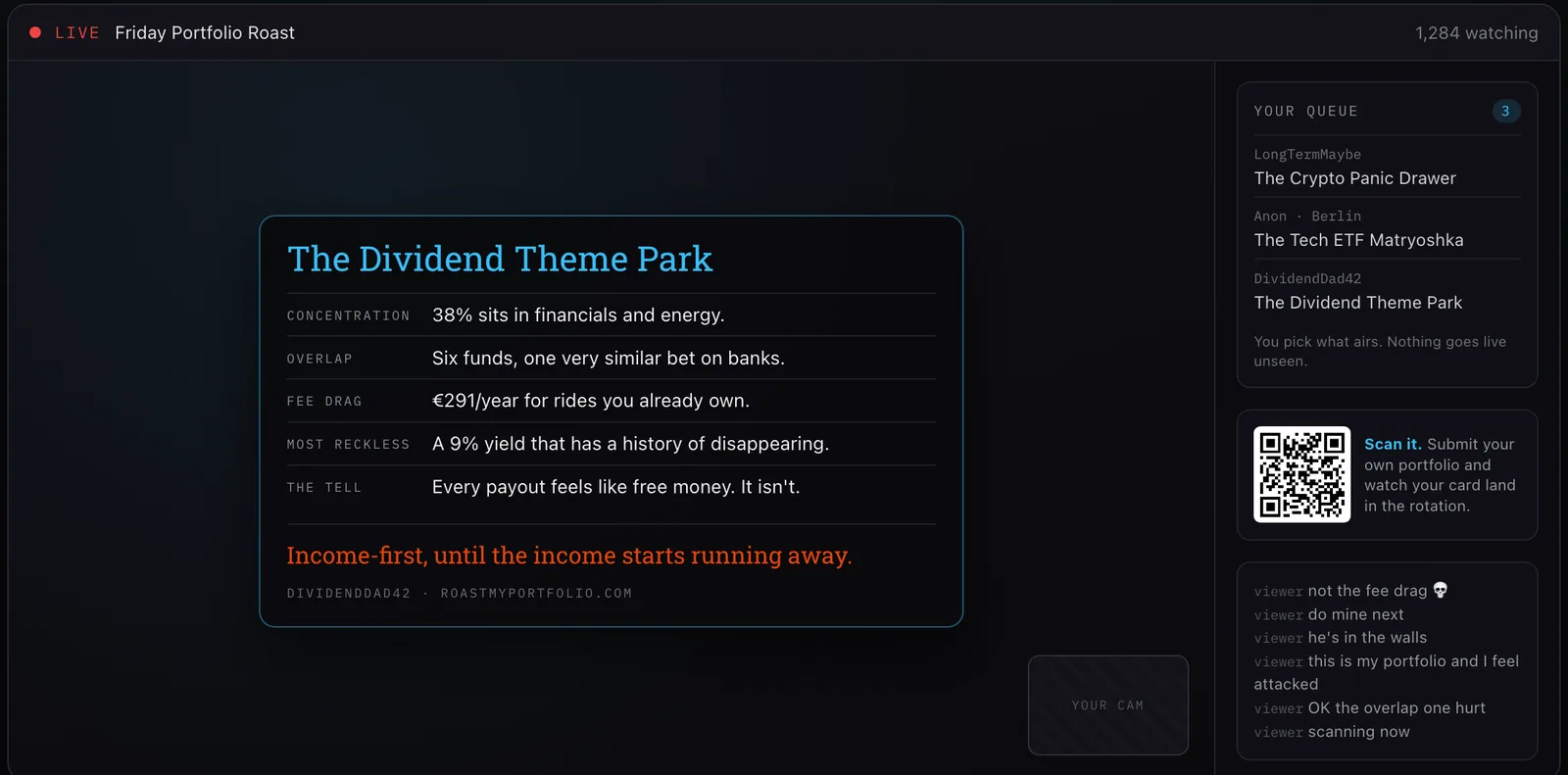 Watch it run live ↗
How a roast night runs
Five steps, once. After the first stream it is one click and a link you already have in OBS.
- 01
Open a room
One click, no account. You get three links: an overlay URL for OBS, a moderation console for you, and a submit link for your audience.
- 02
Add one URL to OBS
Paste the overlay URL in as a browser source. While nothing is on air it shows your room's QR code, so your audience can scan it straight off the stream.
- 03
Your audience submits, anonymously
They scan, paste holdings or upload a screenshot of them, and add a nickname if they feel like it. No account, no login, no broker connection, nothing to trust you with.
- 04
You decide what airs
Every submission lands in your console as pending. Approve the good ones, reject the rest. The server refuses to put an unapproved card on screen, so a mistake in the room can't become a mistake on the broadcast.
- 05
Read the card, keep the clip
An archetype, five findings, one verdict — enough to talk over for ten minutes. Then save it as a 1080×1920 PNG. So can the viewer who sent it.
The fastest way to understand it is to be the viewer for thirty seconds. Open the demo room — scan the QR code on it with your phone, submit anything, and watch your own card join the rotation.
Why the overlay won’t crash your OBS
One URL, no plugin, nothing that can crash. Every streamer has a story about the overlay that turned a broadcast into a slideshow, or the browser source that took OBS down thirty seconds after launch — that fear is well earned, and it is the reason this thing is built the way it is.
No install
One URL, no plugin
You add a browser source and that is the entire setup. There is no executable, no .dll, and nothing that needs updating between streams.
Lightweight
Plain HTML on a transparent background
No video, no WebGL, no embedded players, no ad or analytics scripts running on top of your broadcast. It is text and CSS over your video.
Quiet
One small request every two seconds
The overlay asks the server what is currently on air, and does nothing else. There is no socket to drop and no reconnect storm when your network hiccups.
No surprises
Cookie banners can't appear on it
The consent banner is deliberately not mounted on overlay routes. It cannot composite over your video mid-stream where you have no way to dismiss it.
Considerate
Reduced motion is honoured
A stream capture is video. If a system asks for reduced motion the card appears without animating, rather than not appearing at all.
Testable
Try it before you are live
The demo room is permanently open. Point a browser source at it and watch it behave on your own encoder before you trust it with an audience.
Roast Night vs. a generic stream overlay
The tools most streamers already run were built for gaming audiences and general-purpose alerts. That shows up in what they ask of your viewers, and in what you are left holding after the stream ends.
| Roast Night | Alert & overlay suites | Chat-interaction extensions | |
|---|---|---|---|
| What you install | One URL as a browser source | An account, a dashboard, often a desktop app | A platform extension, plus setup on the viewer's side |
| Does the viewer need an account | No. They scan and type | Usually, to interact at all | Yes — a login, and often channel currency to spend |
| Built for finance content | Yes — concentration, overlap, fees, behaviour | No. Alerts, chat boxes and goal bars | No. Designed to interfere with video games |
| Approval before it airs | Enforced by the server, not just the interface | Varies, and often instant by design | Instant by design — that is the point of it |
| What you can post afterwards | A 1080×1920 PNG per card, for you and the viewer | A VOD you have to clip yourself | A VOD you have to clip yourself |
| What it costs | Free | Freemium, with paywalled tiers | A share of what your viewers spend |
How to review viewer portfolios live without giving financial advice
This is the objection that stops most finance creators, and it deserves a structural answer rather than a bigger disclaimer. Roast Night is designed so that the thing you are doing on camera is commentary on an anonymous allocation — not advice to an identifiable person about their money.
Anonymous by construction
You are not reviewing a client's account. You are reacting to an unattributed asset allocation submitted by someone you cannot identify — and neither can anyone watching.
Holdings only, never credentials
The submit page asks for positions. It tells viewers, in writing, not to include account numbers, broker logins or names. There is no OAuth and no broker connection to hand over.
Comedy, not a recommendation
The output is an archetype and five observations about what a portfolio is already doing. It is retrospective by design and contains no instruction to buy or sell anything.
The disclaimer ships on the card
“Entertainment, not financial advice” is printed into the exported image itself, so it survives being screenshotted, reposted and stripped of its context.
None of this is legal advice, and it does not decide anything for you: your obligations depend on where you are and what you hold yourself out as — see, for instance, the FCA’s guidance for finfluencers. What the format does is remove the two things that usually create the exposure — an identified person, and a recommendation.
Why viewers actually submit
People want their portfolio judged far more than they let on — entire forums exist for little else — but they will not attach their name to it. They use throwaway accounts and they delete their own posts afterwards. Anonymity is not a nice touch here; it is the whole reason anyone participates.
Nothing to sign up for
No account, no email, no OAuth, no broker link. Scan, paste, submit. The lower the ask, the more of your chat takes part.
The text is never stored
What a viewer pastes is analysed in the request and then discarded. Only the resulting card is kept. The safest way to keep a promise about data is to not hold the data.
No IP address is kept
Addresses are used in memory to rate-limit submissions and are never written to the database alongside anything a viewer sent.
They leave with something
A viewer can save their own card the moment they submit, whether or not it ever airs. Getting roasted becomes a thing they have, not just a thing that happened to them.
Every roast is already a vertical clip
The usual way a live moment becomes a short is that you scrub the VOD at midnight and crop it by hand. Here the shareable object is produced at the same moment as the segment: each card exports as a 1080×1920 PNG, sized for Shorts, Reels and TikTok, with no editing step at all.
You save it from the console
One button, next to the card you just aired. It is a post before you have finished talking about it.
So does the person you roasted
They save their own copy from the confirmation screen. People post self-deprecating results about themselves readily — it is the whole reason year-in-review graphics work — and every card carries the site on it.
One submission is a segment
You do not need a big room for this to pay off. A single sharp portfolio is ten minutes of live content and a short you did not have to edit.
Questions creators ask
The ones that decide whether this goes anywhere near a live broadcast, answered with what the software actually does.
Roast Night is entertainment, not advice — viewers submit holdings only, never account numbers, logins, or names. You're commenting on an anonymous allocation, not advising an identified client. Every card carries "Entertainment, not financial advice." That's structural, not a bolted-on disclaimer. It isn't legal advice; check your own jurisdiction's rules.
No. There's nothing to install — no plugin, no DLL. The overlay is one URL added as a browser source: plain HTML and CSS on a transparent background, polling the server every two seconds. No video, no WebGL, no third-party scripts. Test it against your own encoder in the demo room first.
You do, and the server enforces it. Every submission lands in your console as pending. The reveal endpoint refuses to air a pending or rejected card — it returns an error, not a card. Rejecting a card already on screen clears the overlay immediately. You can also clear the screen or close the room anytime.
No signup, no login, no OAuth, no broker connection. A viewer scans your overlay's QR code, pastes their holdings or uploads a screenshot, optionally adds a nickname, and submits — that's the whole flow. Anonymity is why people submit financial information at all, so the product asks for nothing that could identify them.
Submitted text is never written to the database — it's analysed in the request, the card is stored, and the text is discarded. No IP address is stored either; it's used briefly in memory for rate limiting only. What remains is the card: an archetype, five lines, a verdict, and the nickname if one was given.
Nothing. Opening a room is free and takes one click. Each room comes with a submission cap so a public URL cannot run up an unbounded bill, and rooms close automatically six hours after they open.
No. The format does not need mass participation — it needs one good portfolio. A single submission is a ten-minute segment and a vertical clip you can post afterwards. Small rooms often produce sharper content, because you can actually read every card before you air it.
Any platform you broadcast to with OBS, Streamlabs, or another browser-source-capable encoder — YouTube Live, Twitch, and Kick are just destinations. Streaming from a phone with no browser source? Run the room from the moderation console and share exported cards as vertical posts instead.
Every card exports as a 1080x1920 PNG, sized for Shorts, Reels and TikTok, with no editing step. You can save any card from the moderation console, and the viewer who submitted it can save their own copy from their confirmation screen. That second half matters: it is what turns a segment you aired into something your audience posts for you.
Open a room, add one URL to OBS as a browser source, and keep the console open on your phone. The QR code shows on the overlay itself, so viewers scan straight off the stream. Save the console link — a room lives at a key in that URL, not an account, and losing it means losing the room.
Six hours from the moment you open it, after which it closes on its own. Open a fresh room for your next stream — there is no cleanup and nothing to cancel.
Yes, and you should. The demo is a real, permanently open room shown inside a mock stream frame. Scan the QR code on it, submit a portfolio from your phone, and your card joins the rotation you are watching. It is the same pipeline your viewers would hit, running live.
Want someone in the room for your first one?
You do not need us — opening a room is free and takes a click. But if you would rather not debug anything live, we run a small white-glove pilot: we set the room up with you, sit in on the stream, and fix whatever breaks while it is breaking. No card, no contract. If it does not make good content, we both find that out and move on.
Would rather just ask something first? Write to a person.
Email support@roastmyportfolio.comYour next stream has a segment in it
Open a room, drop one URL into OBS, and put the QR code on screen. That is the entire setup.
Roast Night is entertainment and education, not financial advice. Viewers submit holdings only — never account numbers or logins — and the submitted text is never stored.